Does Lifting Weights Burn Fat? Losing Weight at a Weights Gym
Updated by Iron Institute, Haverhill
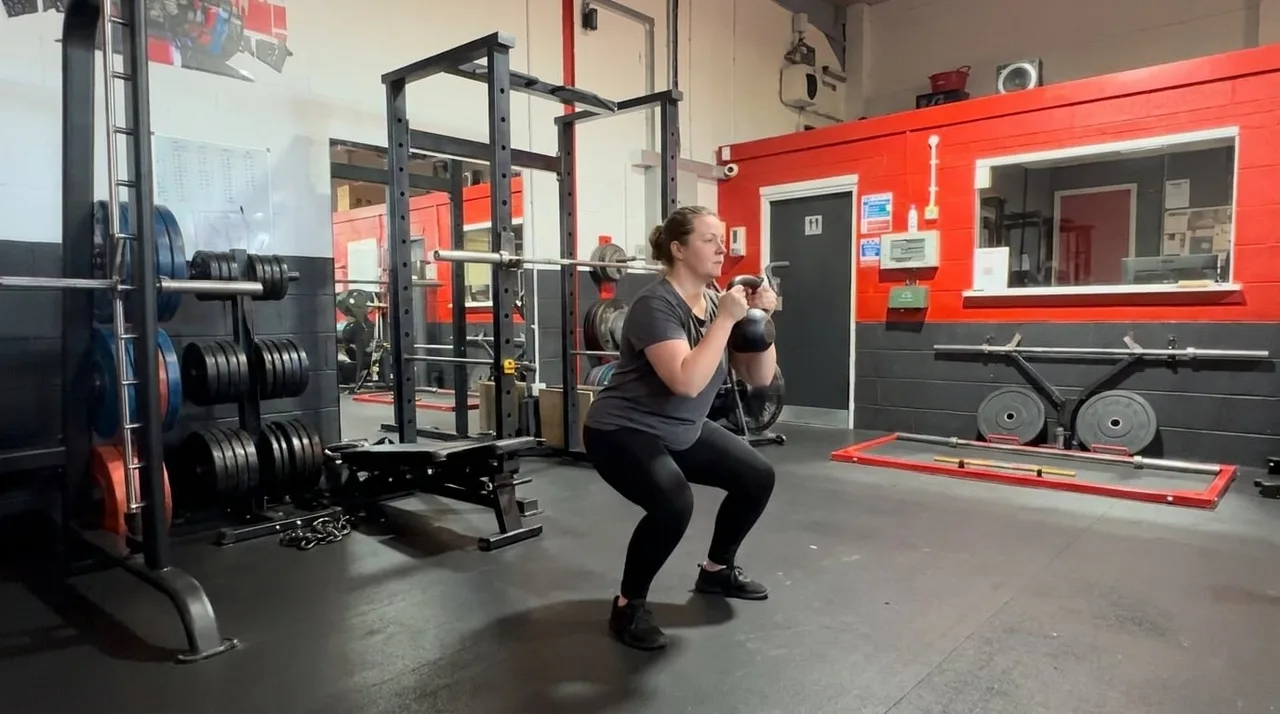
Yes. Lifting weights burns calories while you train and lowers body fat slowly, but on its own it shifted only about half a kilo of fat in around five months, across a 2022 review of 54 trials. The weight comes off mainly by eating a little less than you burn. Where lifting earns its place is keeping your muscle while that happens, so what you lose is fat.
Searches for "does lifting weights burn fat" peak in January. The internet tends to answer with a big yes, and plenty of the confident numbers behind it fall apart when you look them up. We are a strength gym in Haverhill with no treadmills, so we have a stake in the answer. Here is what the evidence says, including the parts that don't flatter weights.
Lifting does burn fat, just not much on its own
The best evidence comes from a 2022 review of 54 trials, published in Sports Medicine, where healthy adults did full-body weight training for at least four weeks and were compared with adults who did no exercise. After about five months on average, at around three sessions a week, their body fat percentage fell by about 1.5 points and their fat mass by about half a kilo on average (Wewege and others). It worked for men and women alike, and it reduced the deeper fat around the organs too.
Half a kilo in five months is real, and it is small. A separate eight-month trial in adults living with overweight or obesity found the group that only lifted weights lost no significant fat, while the group doing aerobic training lost more. The group doing both lost the most, though not significantly more than aerobic training alone, and it took twice as long (Willis and others).
So if anyone tells you that a few sessions under the bar will melt the Christmas weight, the evidence doesn't back them. Lifting is part of the answer. It isn't the whole of it.
Most of the weight comes off in the kitchen
The UK Chief Medical Officers put it in one line: "Diet is the important factor in weight management." Physical activity, they say, plays a supporting role (CMO guidelines).
The NHS advice is to eat around 600 calories a day less than you need, and to aim to lose 0.5 to 1 kg a week. The NHS calls that a safe and sustainable way to lose weight.
Exercise on its own tends to produce small losses. A review of reviews found exercise training alone took off roughly 1.5 to 3.5 kg in adults living with overweight or obesity (Bellicha and others). In trials that compared them directly, programmes built on activity alone lost about 6 kg less after 12 to 18 months than programmes that changed diet as well (Johns and others). None of that makes the gym pointless. It means the gym and the kitchen do different jobs.
What lifting adds when you're losing weight
When you eat less than you burn, your body takes some of the energy from muscle, not just fat. Lifting tells it to keep the muscle. In reviews of people dieting while lifting, weight training saved about 0.8 kg of lean mass compared with dieting alone (Bellicha and others; Sardeli and others). Most of those trials were in older adults or people living with obesity, but the pattern holds across them.
That matters for the result you actually want. Losing weight that is mostly fat is a different outcome from losing weight with a good share of muscle in it. You come out of it with more of your muscle.
The CMOs add a reason that has nothing to do with the scale: people who are overweight or living with obesity reduce their risk of heart disease by being physically active, "irrespective of any change in weight". If the scale is slow one month, the training still counted.
Weights or cardio for weight loss? Do both
Do both if you have the time. Cardio burns more calories per half hour, lifting keeps and builds muscle, and together they do best for losing fat while keeping muscle. These are Harvard Health's rough estimates for half an hour, for someone of about 70 kg (11 stone):
| 30 minutes of | Calories, roughly |
|---|---|
| Weight training, general | 108 |
| Weight training, vigorous | 216 |
| Rowing machine, moderate | 252 |
| Stationary bike, moderate | 252 |
| Walking at 3.5 mph | 133 |
Those figures are US estimates from 2021 and vary with your size and effort. Harvard has no air bike, ski-erg or punch bag row, so treat the table as a rough guide. Effort matters as much as the machine: vigorous weight training comes out close to moderate rowing.
A 2021 analysis of 32 trials in adults living with obesity found that aerobic training took off the most weight, lifting, alone or with cardio, built the most muscle, and doing both was best for losing fat while keeping muscle, though the authors rated the certainty of the evidence low to moderate (Morze and others). If time is short, the NHS and CMO minimum is strength work on at least two days a week plus 150 minutes of moderate activity. No trial in our sources tested which order works better, so do them in the order you will actually stick to.
Three claims you can stop worrying about
"Muscle burns loads of calories at rest"
A little, not loads. A kilo of muscle burns about 13 calories a day at rest, against about 4.5 for a kilo of fat (Wang and others). By our arithmetic from that figure, gaining a kilo of muscle, which takes months, adds roughly 13 calories a day. It helps a little. It won't do the work for you.
"The afterburn keeps burning fat for hours"
Only a little. Your body does use extra energy after a hard session, but a review of the research found that even when the afterburn lasts, it comes to only 6 to 15 percent of what the exercise itself burned, and called earlier optimism about its role in weight loss "generally unfounded" (LaForgia and others). The evidence for weights specifically is limited, but the session itself is what counts.
"Sit-ups burn belly fat"
No. In a six-week trial, abdominal exercises five days a week made no significant difference to belly fat, waist size or body fat (Vispute and others). You can't choose where fat comes off. Whole-body training and eating a little less take fat off across the body, including the deeper fat around the middle.
Why the scale can lie while you train
The scale can sit still or creep up while you train, because lifting adds some muscle. In the eight-month trial above, the lifting-only group gained about 1 kg of lean mass and ended up slightly heavier overall, while their fat barely moved. If your scale sits still or creeps up, some of that can be muscle gained, which is the training working.
The NHS says BMI "cannot tell the difference between muscle and fat". Both the NHS and NICE suggest a simpler check: keep your waist to less than half your height. The NHS says measuring your waist may give you a better idea of your overall health, so a tape measure and a note of what you lifted give you more to go on than the scale alone.
A fat-loss week at a gym without treadmills
We don't have treadmills or cross trainers. Our conditioning kit is an air bike, a rowing machine, a ski-erg and punch bags, and a hard session on any of them is cardio, with no need for an hour of steady jogging.
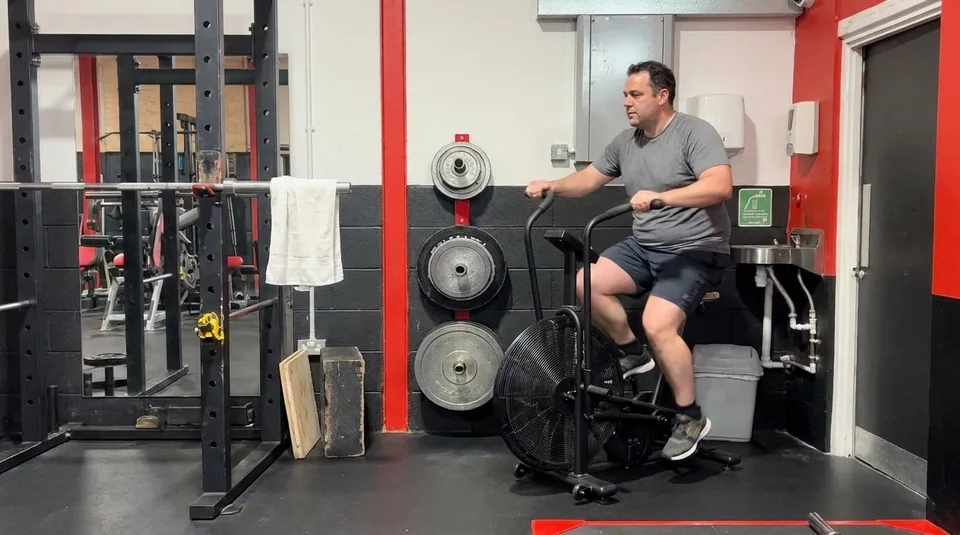
A simple week that fits the guidelines looks like this:
- Three weights sessions. Work the whole body each time: a squat or the leg press, a push such as the chest press, a pull such as the seated row or lat pulldown, and a hinge such as the trap bar deadlift. In the eight-month trial above, people did three sets of 8 to 12 repetitions, three days a week. The NHS and the CMOs ask for strength work on at least two days a week, so three gives you slack for a busy week.
- Some hard cardio. The rower, the air bike or the ski-erg, on a weights day or a separate one, at a pace where talking is hard. In the research, short intervals and steady work lost about the same if the total energy used was the same, so pick whichever you'll actually do.
- Walking on the other days. The guidelines ask for 150 minutes of moderate activity a week, and a brisk walk round Haverhill adds to it.
- Eat a little less. Around 600 calories a day under what you need, per the NHS. The free NHS Weight Loss Plan app gives you a 12-week plan if you want structure.
If the weights floor is the part that worries you, start with the plate-loaded machines, which guide the movement while you learn. Our post on gym anxiety in a weights gym covers your first few sessions.
Losing weight at Iron Institute in Haverhill
Iron Institute is a 24/7 strength gym at Unit 55 Hollands Road, Haverhill. If you are happy to lift and do your cardio on an air bike, rower or ski-erg, it works for losing weight: there are racks, deadlift platforms, plate-loaded machines, dumbbells and kettlebells, plus an air bike, a rowing machine, a ski-erg and punch bags, and no treadmills or cross trainers. If your favourite cardio is a long run on a treadmill, we are not set up for that.
Membership is £30 a month, or £50 for two on a couples membership, with no contract and no joining fee, so a New Year start doesn't lock you in for a year (see membership).
- Open 24/7 with your own key fob, so early mornings and late evenings both work around a January routine.
- Membership is capped, so the floor never gets crazy busy. It is busiest in the morning and straight after work, and quiet the rest of the time. More on the quietest times to train.
- New members are shown round and can ask questions, and you can ask anyone for a spot.
- Free parking on site, a changing area and a water dispenser.
- Our personal trainer offers a free first consultation.
One member's Google review says they came in "completely out of shape" and a few months in felt "stronger, fitter, and more confident than I have in years".
Before you start
The CMOs say the risk of serious harm from physical activity is very low, and that the benefits outweigh the risks. The NHS adds one sensible step: speak to your GP first if you haven't exercised for some time, or if you have a medical condition or a concern. It also suggests seeing a GP if your waist is more than half your height.
If you are taking a weight-loss injection, the CMOs say muscle-strengthening activity is likely to be of particular importance for keeping muscle, though they note the evidence is still emerging. Talk to your prescriber or GP before changing your routine.
Starting in January, still going in March
Physical health, weight loss and eating habits were the most popular New Year resolutions in a Swedish study of more than a thousand people, and 55 percent of those who answered at the one-year mark counted themselves successful, by their own report. People who set goals as something to do, rather than something to stop, did better: 59 percent against 47 percent (Oscarsson and others).
Staying power is the hard part. Records from one gym in Brazil found 63 percent of new members stopped before their third month (Sperandei and others). So set the goal as "lift three times a week and do one hard rower session", not "stop eating biscuits", and pick a gym you can see yourself still using in March. If that might be us, see membership and prices or message us to come and have a look round first.
Weights and weight loss: what people ask
Can you lose weight just by lifting weights?
A little. In trials where healthy adults lifted for about five months, compared with adults who did no exercise, fat mass fell by around half a kilo on average, and the scale may move less than that because you also gain some muscle. To lose more, eat a bit less than you burn, and keep lifting so most of what comes off is fat.
How much cardio should I add to weight training?
The guidelines ask for 150 minutes of moderate activity a week alongside strength work on at least two days. Research points to doing both for the best fat loss, so a hard block on the rower, air bike or ski-erg, plus walking on other days, is one way to build towards it.
Does lifting weights burn more calories than cardio?
Per half hour, usually not. Harvard Health estimates about 108 calories for general weight training against about 252 for moderate rowing, for someone of around 70 kg. Vigorous weight training, at about 216, comes close. These are rough US estimates.
What type of lifting burns the most fat?
In the review of 54 trials, neither how much people lifted nor which exercises they did was linked to how much fat they lost. Effort does change what a session burns: Harvard estimates vigorous weight training at about double the calories of general weight training.
Does lifting weights burn belly fat?
Not from the belly on its own. In one trial, six weeks of abdominal exercises five days a week made no significant difference to belly fat. Whole-body training does reduce the deeper fat around your organs over time, and the NHS suggests keeping your waist under half your height.
Will I look slimmer if I lift weights?
Possibly, but slowly. One of the authors of the 54-trial review warned that the number on the scales will not look as low as it would after aerobic training. The NHS says you may get a better idea of your overall health from measuring your waist.
Sources
- Calories and weight loss, NHS Better Health. Checked on 10 November 2026.
- Overweight and obesity in adults, NHS. Checked on 10 November 2026.
- Physical activity guidelines for adults aged 19 to 64, NHS. Checked on 10 November 2026.
- UK Chief Medical Officers' Physical Activity Guidelines, Department of Health and Social Care. Checked on 10 November 2026.
- Overweight and obesity management (NG246), NICE. Checked on 10 November 2026.
- The effect of resistance training in healthy adults on body fat percentage, fat mass and visceral fat (Wewege and others, 2022), Sports Medicine. Checked on 10 November 2026.
- UNSW Sydney news release on the resistance training and body fat review (22 September 2021), EurekAlert!. Checked on 10 November 2026.
- Effect of exercise training on weight loss, body composition changes, and weight maintenance (Bellicha and others, 2021), Obesity Reviews. Checked on 10 November 2026.
- Diet or exercise interventions vs combined behavioral weight management programs (Johns and others, 2014), Journal of the Academy of Nutrition and Dietetics. Checked on 10 November 2026.
- Impact of different training modalities on anthropometric outcomes in patients with obesity (Morze and others, 2021), Obesity Reviews. Checked on 10 November 2026.
- Effects of aerobic and/or resistance training on body mass and fat mass (Willis and others, 2012), Journal of Applied Physiology. Checked on 10 November 2026.
- Resistance training prevents muscle loss induced by caloric restriction in obese elderly individuals (Sardeli and others, 2018), Nutrients. Checked on 10 November 2026.
- Specific metabolic rates of major organs and tissues across adulthood (Wang and others, 2010), American Journal of Clinical Nutrition. Checked on 10 November 2026.
- Effects of exercise intensity and duration on the excess post-exercise oxygen consumption (LaForgia and others, 2006), Journal of Sports Sciences. Checked on 10 November 2026.
- The effect of abdominal exercise on abdominal fat (Vispute and others, 2011), Journal of Strength and Conditioning Research. Checked on 10 November 2026.
- Calories burned in 30 minutes for people of three different weights, Harvard Health Publishing. Checked on 10 November 2026.
- Adherence to physical activity in an unsupervised setting (Sperandei and others, 2016), Journal of Science and Medicine in Sport. Checked on 10 November 2026.
- A large-scale experiment on New Year's resolutions (Oscarsson and others, 2020), PLOS ONE. Checked on 10 November 2026.
Come and have a look round
Message us to arrange a look round before you join. £30 a month, no contract and no joining fee. Tap Join Now and pick how you want to get in touch.